
Benefits of Dental Implants
Your smile deserves a fresh start; discover the benefits of dental implants for improving chewing and speech, and for replacing missing teeth with a stable solution that looks and feels natural.
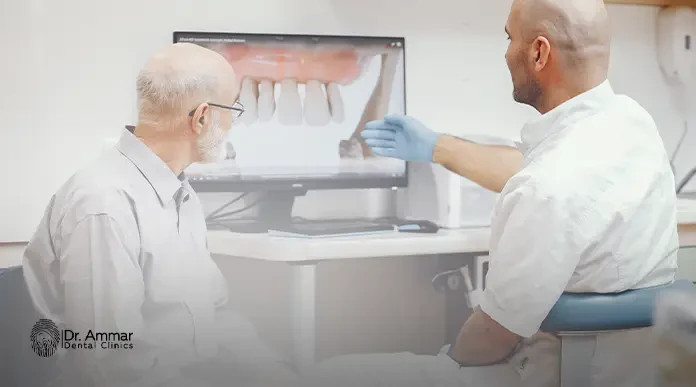
Have you lost a tooth and started avoiding certain foods or hiding your smile in photographs? Tooth loss affects more than just your appearance; it can cause difficulty chewing and speaking, and lead to progressive jawbone resorption over time. Dental implants serve as an effective solution to replace missing teeth and fully restore oral function.
In this article, we cover the importance of dental implants, how they differ from traditional prostheses, their expected lifespan, treatment steps, post-operative care, and the advantages offered by Dr. Ammar Dental Clinics.
What Are Dental Implants?
A dental implant is a medical procedure designed to replace missing teeth. It involves surgically placing a biocompatible fixture into the jawbone to serve as an artificial root, onto which a natural-looking crown or bridge is attached to restore form and function. Fixtures are typically crafted from medical-grade titanium that integrates seamlessly with bone tissue.
A complete dental implant structure consists of three main components:
The Implant Fixture: Surgically anchored into the jawbone, acting as an artificial tooth root.
The Abutment: A connecting piece that joins the implant fixture to the final crown or restoration.
The Artificial Crown: The visible portion of the tooth, custom-crafted to mirror natural tooth shade and support chewing.
Once osseointegration is complete and the final crown is fitted, patients can eat, speak, and smile with confidence.
Schedule your consultation at Dr. Ammar Dental Clinics to evaluate your candidacy for dental implants and explore your personalized treatment options.
Key Benefits of Dental Implants
Unlike removable options, dental implants go beyond filling empty spaces—they actively preserve surrounding oral structures and restore natural function. Key advantages include:
Restored Chewing Function: Enables comfortable eating across a full diet, particularly after replacing lost molars.
Enhanced Smile Aesthetics: Custom crowns are matched in shade, size, and shape to adjacent natural teeth.
Jawbone Preservation: Stimulates the surrounding bone, significantly reducing bone loss at the extraction site.
Protection of Adjacent Teeth: Replaces missing units without shaving down healthy neighboring teeth (unlike traditional dental bridges).
Improved Speech Clarity: Fixed prostheses prevent phonetic distortion caused by tooth gaps.
Boosted Self-Confidence: Restores a complete smile, enhancing daily social and professional interactions.
Superior Stability: Anchored within the jawbone, eliminating the slipping or clicking associated with removable dentures.
Long-Term Durability: Designed to last for decades—or even a lifetime—with proper hygiene and clinical care.
Outcomes depend on individual bone quality, periodontal health, and pre-surgical diagnostic planning. Our clinical team at Dr. Ammar Dental Clinics prioritizes comprehensive evaluations to choose the optimal restorative protocol for each patient.
Importance of Dental Implants for Oral and Jaw Health
When a tooth is lost, the surrounding alveolar bone gradually resorbs, and adjacent teeth can shift into the empty space, altering your bite alignment. Implant fixtures preserve bone volume by transmitting natural masticatory forces into the jaw framework. Furthermore, they function independently without placing structural stress on neighboring teeth.
Dental Implants vs. Traditional Options
When replacing missing teeth, patients often evaluate dental implants alongside traditional fixed bridges or removable dentures. The comparison table below highlights the key differences:
Comparison Point | Dental Implants | Traditional Options (Bridges & Dentures) |
Fixation Method | Surgically anchored into the jawbone to support an independent crown. | Bridges rely on adjacent natural teeth; removable dentures rest on gums and remaining teeth. |
Stability | Exceptional stability following osseointegration. | Dependent on anchor tooth strength or denture fit; removable options may slip during use. |
Preservation of Adjacent Teeth | Zero alteration or shaving of neighboring healthy teeth required. | Traditional bridges require reducing/grinding down adjacent healthy enamel. |
Jawbone Preservation | Actively stimulates the jawbone and prevents bone resorption. | Does not provide root stimulation, leading to progressive bone loss under the site. |
Lifespan | Can last a lifetime with proper care and maintenance. | Bridges and dentures typically require replacement or refitting every 5–15 years. |
Treatment Timeline | Takes several months to allow for complete bone healing (osseointegration). | Generally completed faster over fewer clinical visits. |
Upfront Cost | Higher initial investment. | Lower initial upfront cost, though long-term replacement costs may accrue. |
Step-by-Step Dental Implant Procedure
The dental implant process relies on a structured sequence designed to deliver predictable, safe outcomes:
Initial Assessment & Diagnosis: Comprehensive clinical exam and 3D imaging (CBCT) to evaluate bone density and plan exact implant placement.
Pre-Surgical Oral Preparation: Treating any active periodontal inflammation or caries, and performing bone grafting if bone volume is deficient.
Surgical Implant Placement: Precision placement of the titanium fixture into the jawbone under local anesthesia.
Osseointegration Period: A healing period lasting 3 to 6 months to allow the jawbone to fuse securely around the implant.
Abutment and Crown Attachment: Attaching the connecting abutment and securing the final, custom-fabricated crown once integration is verified.
Routine Maintenance & Follow-Up: Regular checkups to evaluate soft tissue health and monitor long-term restoration stability.
Digital dentistry workflows utilized at Dr. Ammar Dental Clinics streamline this process, maximizing precision and minimizing post-operative discomfort.
Expected Lifespan and Influencing Factors
A common question among patients is: How long do dental implants last? While the internal titanium fixture can last a lifetime, the external crown may undergo natural wear over 15+ years and require standard maintenance or replacement.
Factors Influencing Implant Longevity:
Periodontal Health: Maintaining healthy gums prevents peri-implantitis (inflammation around the implant).
Jawbone Quality: Adequate bone volume provides strong, stable support.
Daily Oral Hygiene: Brushing, flossing, and using interdental cleaners prevent bacterial buildup.
Smoking: Tobacco use impairs tissue healing and increases the risk of implant failure.
Systemic Health: Uncontrolled chronic conditions (e.g., unmanaged diabetes) can affect bone integration.
Occlusal Force & Bruxism: Unmanaged teeth grinding or excessive bite force can place excess stress on the crown.
Candidate Suitability
While highly effective, dental implants are not automatically suited for every clinical presentation. Patients requiring specialized pre-treatment evaluation include:
Individuals with active, untreated periodontal disease.
Patients with severe jawbone loss (requiring preliminary bone grafting or sinus lifts).
Individuals with uncontrolled systemic conditions (e.g., uncontrolled diabetes).
Heavy smokers unable to refrain during the surgical recovery phase.
Younger patients whose jawbone growth is not yet complete.
Thorough diagnostic imaging ensures that any pre-existing issues are resolved before surgery begins.
Potential Risks and Complications
As with any minor surgical procedure, potential side effects can occur, though proper planning significantly minimizes risks:
Temporary post-surgical swelling or mild discomfort.
Localized infection or peri-implantitis if hygiene is neglected.
Failure of osseointegration (leading to implant mobility).
Proximity to anatomical structures (e.g., nerves or sinus cavities requiring precise 3D mapping).
Working with an experienced implant specialist and utilizing 3D digital planning ensures these risks are kept to an absolute minimum.
Essential Post-Treatment Care Tips
To maintain your dental implants and extend their lifespan:
Maintain Rigorous Oral Hygiene: Brush twice daily with a soft-bristled brush and non-abrasive toothpaste.
Clean Interdental Spaces: Use dental floss or specialized interdental brushes around implant crowns.
Attend Regular Checkups: Routine professional hygiene visits help detect potential issues early.
Avoid Tobacco Products: Smoking adversely affects soft tissue attachment and bone stability.
Protect Restorations from Excessive Stress: Avoid chewing extremely hard objects or using your teeth as tools.
Monitor for Warning Signs: Consult your dentist immediately if you experience persistent swelling, bleeding, or fixture mobility.
Why Choose Dr. Ammar Dental Clinics for Dental Implants?
At Dr. Ammar Dental Clinics, we combine clinical expertise with state-of-the-art digital dentistry to deliver safe, highly predictable dental implant restorations:
Multidisciplinary Expertise: Specialized surgical teams trained at top Egyptian and European institutions.
3D Digital Guided Surgery: Utilizing 3D CBCT imaging and digital workflows for precise implant positioning.
World-Class Implant Systems: Partnering with leading global manufacturers, including Swiss Straumann systems.
Full-Arch Solutions: Expertise in single-tooth replacement as well as full-mouth rehabilitations (All-on-4® and All-on-6® protocols).
Transparent Pricing: Clear cost breakdowns and flexible package options outlined before treatment begins.
Structured Follow-Up: Continuous post-surgical monitoring to safeguard long-term results.
Convenient Locations: Modern, fully equipped branches across New Cairo, Heliopolis, Sheikh Zayed, and Mansoura.
Replacing missing teeth restores your masticatory function, protects your jawbone, and revives your smile confidence.
Contact Dr. Ammar Dental Clinics today to schedule your consultation and take the first step toward a healthy, complete smile.