
Dental implantation using stem cells
Discover the latest research on stem cell-based dental regeneration, and how it may contribute in the future to regenerating dental tissues and developing more effective treatments.
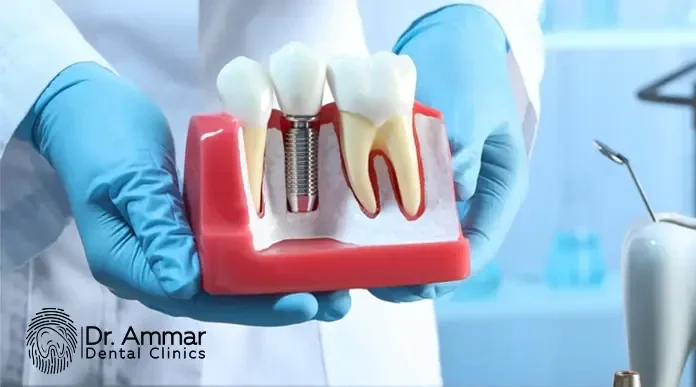
Tooth loss is a common problem that impairs chewing efficiency and smile aesthetics, driving many individuals to seek modern techniques to replace damaged tissues and restore oral functionality. Among the fields capturing increasing attention is stem cell dental implants, as ongoing research into stem cells opens promising horizons for regenerating oral and dental tissues.
In this article, we explore the feasibility of stem cell dental implants, their potential advantages and disadvantages, the success rate of stem-cell-based dental treatments, the differences between this emerging technique and traditional dental implants, and the role of Dr. Ammar Dental Clinics in providing cutting-edge dental implant services. Read on to learn more.
What Are Stem Cell Dental Implants?
Stem cell dental implants represent a promising frontier in regenerative dentistry. The concept relies on harnessing the unique ability of stem cells to grow and differentiate into specialized cell types, which may eventually help regenerate damaged tissues within the mouth and jaw.
Stem cells are sourced from various biological origins, including natural dental tissues, bone marrow, and adipose tissue. Researchers are actively studying how to isolate these cells, culture them in a laboratory, and direct them to form specific tissues—such as alveolar bone and periodontal ligament support—with the goal of developing future regenerative treatments.
However, using stem cells to fully replace missing teeth is still in the research and development phase and has not yet become a routine, approved clinical procedure like traditional dental implants. Therefore, choosing the right treatment requires a careful evaluation of your oral and jaw health alongside a specialized dental practitioner.
If you are seeking information about stem cell dental implants or looking for reliable solutions to replace missing teeth today, contact Dr. Ammar Dental Clinics to schedule your consultation and explore customized treatment options tailored to your dental condition.
- Book your appointment Reach us whichever way suits you best.
Advantages of Stem Cell Dental Implants
Stem cell dental implants hold exciting potential in regenerative dentistry due to the capacity of stem cells to generate new tissue and repair damage. While growing entirely new teeth is still under scientific investigation, researchers highlight several potential benefits:
Enhanced Biocompatibility: Utilizing cells harvested directly from the patient’s own body minimizes rejection risks.
Promoting Tissue Regeneration: Supports natural healing and cellular repair mechanisms.
Reducing Future Surgical Interventions: Potentially minimizing the need for complex secondary surgeries.
Accelerated Recovery: Supporting faster healing and an earlier return to daily routines.
Decreasing Bone Grafting Needs: Potentially reducing reliance on supplementary bone augmentation procedures.
Optimizing Functional & Aesthetic Outcomes: Aiming for more biologically integrated restorations.
Pioneering Future Therapies: Unlocking new avenues for treating severely damaged dental structures.
In summary, stem cell dental implants represent an inspiring direction in modern dental science, offering future possibilities for tissue regeneration and tooth replacement.
Potential Disadvantages and Challenges
Despite the promising benefits of stem cell dental treatments, their application in replacing missing teeth presents several challenges and limitations that must be considered:
High Cost: Laboratory processing, cell culture, and specialized biotechnological protocols significantly increase expenses compared to traditional implants.
Procedural Complexity: Handling and directing stem cells require advanced laboratory facilities, precise techniques, and specialized expertise.
Risk of Treatment Failure: Cultured cells may occasionally fail to proliferate or differentiate into the targeted functional tissues as anticipated.
Limited Availability: These experimental applications are not widely accessible and are generally restricted to advanced research medical centers.
Uncertain Long-Term Outcomes: Long-term safety, durability, and clinical efficacy data remain limited and require extensive further clinical trials.
Given these challenges, evaluating your oral health with an experienced clinician remains the essential first step to understanding proven treatment options. Contact Dr. Ammar Dental Clinics to discover reliable solutions suited to your needs.
What Is the Success Rate of Stem Cell Dental Treatments?
The success rate of stem-cell-based dental procedures depends heavily on variables such as the specific type of stem cell used, cell viability, laboratory processing methods, the biological capacity of surrounding tissues to integrate, and patient compliance with post-operative guidelines. Because stem cell dental implants are still experimental and under active development, no standardized success rate currently exists. Outcomes are dictated by:
The specific source and lineage of the stem cells.
Cellular health and vitality.
Laboratory protocols and scaffold integration.
The jawbone's ability to support regenerative tissue growth.
Patient adherence to post-treatment care.
The expertise of the medical and surgical team.
- Book your appointment Reach us whichever way suits you best.
Stem Cell Implants vs. Traditional Dental Implants
Stem cell dental implants differ fundamentally from traditional implants in their therapeutic mechanism and clinical availability. Traditional implants rely on anchoring a titanium fixture into the jawbone, whereas stem cell research focuses on biological regeneration.
Comparison Point | Stem Cell Dental Implants | Traditional Dental Implants |
Replacement Mechanism | Research aims to regenerate dental tissues and eventually grow new biological teeth. | Relies on a titanium artificial root surgically anchored into the jawbone to support a crown. |
Clinical Availability | Still in the research, experimental, and development phase. | Established, routine clinical procedure widely available in dental practices. |
Materials Used | Stimulates the patient's own harvested autologous stem cells. | Utilizes biocompatible artificial roots manufactured from medical-grade titanium or zirconia. |
Treatment Duration | No fixed clinical timeline as the technology remains experimental. | Typically spans 3 to 6 months to allow complete osseointegration. |
Primary Goal | Developing future biological methods to replace missing teeth. | Restoring missing teeth, masticatory efficiency, and natural smile aesthetics immediately. |
Risks & Safety | Long-term safety and biological efficacy require extensive clinical studies. | Established risks include localized infection, implant non-integration, or rare surgical complications. |
Expected Cost | Projected to be significantly higher than conventional implant procedures. | Ranging from 12,000 EGP to 25,000 EGP per single tooth (based on country and system). |
Choosing the right approach depends entirely on your jaw health, clinical requirements, and expert professional guidance. At Dr. Ammar Dental Clinics, we carefully evaluate your oral structure to present proven, effective treatment options. Contact us today to book your consultation.
Dr. Ammar Dental Clinics: Advanced Dental Care
While stem cell dental implants represent the future of dentistry, selecting an experienced clinician utilizing established, advanced technology is vital for restoring your smile today. At Dr. Ammar Dental Clinics, we combine clinical expertise with modern digital workflows to deliver comprehensive, predictable implant solutions.
Why Choose Dr. Ammar Dental Clinics?
Extensive Experience: Over 10 years of specialized excellence in dental surgery and implantology.
Comprehensive Oral Diagnostics: Thorough clinical assessments of teeth, gums, and jawbone density before initiating treatment.
Modern Digital Technology: Utilizing advanced diagnostic tools to ensure precision and safety.
Transparent Treatment Planning: Clear, detailed explanations of all available restorative steps before care begins.
Structured Coordination: Seamless treatment scheduling for all patients, including dedicated coordination for those traveling from abroad, particularly from Saudi Arabia.
Dedicated Post-Operative Care: Rigorous follow-up protocols to monitor healing and safeguard long-term results.
Take the First Step Toward Your Restored Smile
Stem cell dental implants remain an inspiring horizon for future tooth replacement, but restoring your smile today relies on proven, state-of-the-art clinical solutions.
At Dr. Ammar Dental Clinics, our specialized team is ready to evaluate your condition and guide you toward a healthy, confident smile. Contact us today to book your consultation!
- Book your appointment Reach us whichever way suits you best.