
Dental Implants in Egypt and the Middle East
In Egypt and the Middle East, dental implants serve as a modern solution for replacing missing teeth, restoring chewing function, and bringing back a natural-looking, confident smile.
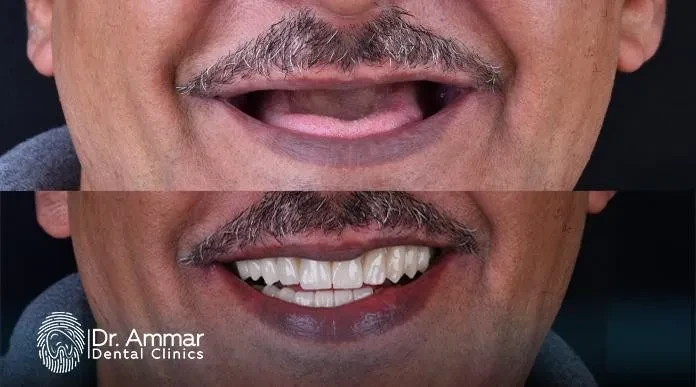
Dental implants are the closest permanent solution to a natural tooth for replacing missing teeth, as titanium artificial roots are fixed in the jawbone to support a permanent, non-moving tooth and protect the jawbone from resorption. They replace both the root and the crown, not just the crown, which distinguishes them from traditional restorations and bridges.
At Dr. Ammar’s Dental Clinics—one of the largest dental institutions in Egypt and the Middle East—we treat each case as a carefully studied treatment plan: from reading 3D cone-beam computed tomography (CBCT) to digital planning and selecting the most appropriate implant type. This guide answers everything on your mind before you decide, in clear language with scientifically documented information.
📌 Key Takeaways
Dental implants replace both the root and the crown, providing stability and function closer to a natural tooth than a removable denture or bridge.
Types include single implants, molar or front tooth replacement, implant-supported bridges, All-on-4, and immediate implants.
The duration is usually 3 to 6 months for osseointegration to complete, with faster immediate solutions for selected cases.
Cost ranges from 15,000 to 25,000 EGP depending on the implant type and bone condition (estimated — determined after examination).
The most crucial factor for success is accurate diagnosis, digital planning, implant type, and regular follow-up — not the lowest price.
What is a dental implant? A dental implant is a procedure in which a titanium artificial root is placed inside the jawbone to act as a strong anchor supporting a tooth, bridge, or fixed denture. Titanium is a biocompatible material with the body, and what gives the implant its strength is that bone grows around it and secures it in a process known as «Osseointegration».
The implant consists of three parts:
Root (Implant): The part fixed inside the bone, replacing the missing tooth root.
Abutment: The connection ring between the root and the crown above the gum line.
Crown: The visible part designed to match the color and shape of your teeth.
Why titanium specifically? Because it is lightweight, strong, corrosion-resistant, and allows bone cells to attach directly to its surface. Modern implant surfaces have been developed to have microscopic roughness, which accelerates integration and increases early implant stability—one of the reasons for high success rates in recent decades.
The core advantage is that the implant replaces the root itself. After losing a tooth, the jawbone begins to resorb due to a lack of stimulation, which can affect facial features; the implant restores this stimulation, thereby preserving the bone.
When do you need a dental implant? You need an implant when you lose one or more teeth, or when you want a fixed alternative to a removable denture, provided there is sufficient jawbone and good gum health. It is a suitable option for most healthy adults, and your candidacy is determined precisely after examination and imaging.
Most common cases:
Loss of a single tooth (molar or front tooth) without filing down adjacent teeth.
Loss of several adjacent teeth via an implant-supported bridge.
Loss of all teeth in the jaw via solutions like All-on-4.
Discomfort with a removable denture and a desire for permanent stability.
Factors that require special evaluation do not necessarily prevent implantation, but require careful planning:
Smoking, and it is preferred to reduce or quit before the procedure.
Diabetes, provided it is controlled (implant success remains comparable to non-diabetics when HbA1c is controlled below 8%).
Jawbone deficiency, treated with bone grafting.
History of gum disease, as the risk of peri-implantitis increases by about 2.3 times, so we treat the gums first.
Can dental implants be performed without sufficient bone? Yes; if the jawbone is insufficient, we prepare it with bone grafting or sinus lifting prior to implantation, and many cases described as "without bone" become implantable after conditioning. These are common and safe procedures.
Bone Graft: Adding bone material to replace a deficiency — from an autogenous source, safe processed materials, or biocompatible synthetic materials, depending on the volume of deficiency.
Sinus Lift: In the upper posterior jaw when the bone beneath the sinus is thin, we lift the membrane and add bone to allow an implant of adequate length.
Sometimes the graft is performed in the same session as the implant, and sometimes we separate the two stages. The decision is made after carefully reading the 3D CT scan.
What are the types of dental implants? Types vary depending on the number of missing teeth and the timing of placement, including single implants, implant-supported bridges, full-jaw implants, and immediate implants. The choice depends on your clinical condition, not a preconceived preference.
Type | Usage | Advantage |
Single implant (molar/front tooth) | Replacing a single tooth | Preserves adjacent teeth |
Implant-supported bridge | Several adjacent teeth | Stability without a removable denture |
Loss of all jaw teeth | Fixed arch on 4–6 implants | |
Immediately after extraction | Fewer sessions and shorter time |
Implants also vary according to the manufacturer, product tier, and technology — not by country of origin as some might think, which directly affects stability, warranty, and cost:
The advanced tier includes some of the world's strongest systems such as Megagen (AnyRidge / Blue Diamond) and bredent.
The Straumann group (Straumann with its BLX/BLT/TL lines) is considered the global gold standard with outstanding research, surfaces, and alloys.
Every country has top-tier companies and economical ones — so we categorize by company and tier, not by country.
Full details in Types of Dental Implants (Companies and Tiers).
Brand selection is not based on the name alone, but on its suitability for your clinical condition, bone density, and tooth position. We explain all types, brands, and prices in detail on the Types of Dental Implants page.
What are the steps of dental implants? Implants go through four stages: evaluation and planning, surgical implant placement, osseointegration, and finally crown restoration. The procedure is performed under local anesthesia, and most patients quickly return to their activities.
Evaluation and Planning. Comprehensive examination and 3D CT scans to measure bone density and determine implant position, angle, and depth. The accuracy of this stage directly reflects on success.
Implant Placement. The root is fixed in the bone under local anesthesia in a short session, using a digital surgical guide in suitable cases.
Osseointegration. Bone grows around the implant over weeks to months until it becomes a single unit with it, and a temporary crown may be placed in the meantime.
Final Restoration. We take precise impressions (mostly digital scanning) and design the crown to match your teeth, then fix it.
Practical details in the Steps and Stages of Dental Implants guide.
How do digital solutions increase implant precision? Digital planning and computer-guided surgery clearly increase implant placement precision compared to the manual method, reducing risks and improving results. We plan the case on imaging software before any intervention and determine the position, angle, and depth beforehand.
A meta-analysis showed that the mean angular deviation was about 2.6 degrees with the full surgical guide compared to about 7.5 degrees in the manual method — significantly higher precision.
Practically, this means: digital mouth scanning instead of annoying traditional impressions for greater comfort and higher accuracy, a 3D surgical guide custom-made for your case to transfer the plan from screen to mouth, and a CAD/CAM designed and manufactured crown for a more precise match with your teeth. The result: placing the implant in the optimal position away from nerves and sinuses, a more precise aesthetic result, more balanced chewing, and reduced likelihood of complications in complex cases.
How long do dental implants take? What is the recovery timeline? Implants usually take 3 to 6 months from implant placement to the final crown, depending on the rate of osseointegration and each patient's condition. Implant placement itself is a short session; the longer part is bone healing.
Approximate recovery timeline:
First 24–48 hours: Minor swelling and discomfort controlled with painkillers and cold compresses.
First week: Swelling subsides, soft foods are recommended.
Subsequent weeks: Full return to activity while healing continues quietly.
After 3–6 months: Complete integration and crown placement.
In selected cases, Immediate Implants allow placing the implant and temporary crown immediately after extraction in a shorter time.
Are dental implants painful or dangerous? Dental implants are a safe procedure performed under local anesthesia, and most patients describe the pain afterwards as less than expected and manageable with simple painkillers. Serious complications are rare with good planning and specialized execution.
During the procedure you feel no pain thanks to local anesthesia, and afterwards minor swelling may occur for days and gradually disappear. More details in Are Dental Implants Painful? and Post-Implant Care. Factors like smoking increase the risk of failure, especially in the upper jaw according to long-term follow-up.
Do dental implants have disadvantages? Yes, dental implants have real disadvantages that should be known: they are more expensive than bridges and dentures, take months, require sufficient bone (or grafting), and peri-implantitis can occur if hygiene is neglected. However, they are the longest-lasting and best at preserving jawbone — and complete honesty about pros and cons is part of our medical responsibility.
Most of these disadvantages can be managed with proper planning. Higher cost is justified by longer lifespan and bone preservation, and eased by installment plans. Longer time is the price of osseointegration that gives the implant permanent stability, which immediate implants shorten in selected cases. Bone deficiency is solved by bone grafting. Peri-implantitis is prevented by hygiene and regular follow-up. We discuss each disadvantage and how to avoid it in detail, and answer questions like "Do they cause cancer?" and "Do they last a lifetime?" on the Disadvantages of Dental Implants — The Full Truth page.
How much do dental implants cost? The cost of dental implants at Dr. Ammar’s clinics starts from 15,000 and reaches about 25,000 EGP or more depending on the implant type and bone condition. Final cost is determined after examination and imaging. Prices are estimated and indicative (last update: June 2026).
Price does not just reflect a "piece" — but the implant type, its origin, warranty level, digital solution precision, and executing expertise. Implants are divided into clear tiers:
Tier | Approximate Price (EGP) | What Makes It Stand Out |
Premium | 15,000 – 17,000 | High stability and extended warranties — reliable internationally approved types |
Advanced (Most Chosen) | Starts from 20,000 | World's strongest systems (Megagen AnyRidge/Blue Diamond · bredent) |
Straumann (The Gold Standard) | From 25,000 | Highest global level |
There are economic types in the market at lower prices, but we chose not to work with them — to maintain the highest long-term success rates. The price difference is small compared to a huge difference in stability and warranty over the years; we choose what lasts.
What specifically determines the price of your case involves several factors: number of missing teeth, bone condition and need for grafting or sinus lift, implant and crown type, and whether the case is immediate or staged. Therefore, the final price is determined only after examination and reading scans.
Full details and installment options on the Cost of Dental Implants in Egypt page.
Dental Implants for Patients from Outside Egypt (Medical Tourism) At Dr. Ammar's clinics, we welcome patients from Saudi Arabia, Gulf countries, and Arabs wishing to get dental implants in Egypt, coordinating the timeline to suit the stay as much as possible. Combining global quality with competitive pricing makes Egypt a preferred destination for dental implants in the region.
We provide remote pre-evaluation of the case via scans and photos, digital planning that reduces the number of visits, and solutions like Immediate Implants and All-on-4 that suit those wanting to accomplish most during a single visit. We also accommodate the stay period in planning, determining what can be done in the first visit and what requires a short follow-up visit, with remote follow-up after returning. Contact us to organize your treatment trip according to your schedule.
Illustrative Example from Our Experience In complex cases, digital planning makes the difference between an average result and an exceptional one. The following example is illustrative and reflects our approach (not representing a specific case).
A patient lost a posterior molar in the upper jaw years ago, and the bone beneath the maxillary sinus resorbed until it became insufficient — a case that might be described as "without bone." Our plan: reading the 3D CT scan, then a sinus lift and bone graft, then placing the implant with a digital guide ensuring angle and depth away from the sinus, and finally the matching crown. Result: a stable tooth functioning with natural efficiency in a position that seemed impossible.
What are the alternatives to dental implants? The most prominent alternatives are the fixed bridge and removable denture, but they do not replace the tooth root, making them less effective in preserving the jawbone. The choice is a clinical decision depending on your condition and budget.
Option | Stability | Bone Preservation | Filing Adjacent Teeth |
Implant | Highest | Yes | No |
Fixed Bridge | High | No | Yes |
Removable Denture | Lowest | No | No |
Complete comparison in Dental Implants vs. Bridge/Restoration?, and all options neutrally in Alternatives to Dental Implants.
🔗 Implants are part of an integrated smile plan that may include Fixed Prosthetics and Cosmetic Dentistry and Veneers.
What maintains the success of an implant for years? A successful implant requires lifelong care and monitoring like a natural tooth, because neglecting hygiene can lead to peri-implantitis and loss of supporting bone. An implant is not "place and forget," but an investment to be maintained.
Peri-implantitis affects about 19.5% of patients, often related to poor hygiene, smoking, or history of gum disease.
To protect your implant: meticulous daily hygiene, follow-up visits every 6 months to spot any early sign, gum treatment, and quitting smoking. When a problem arises, we deal with it early — review Dental Implant Failure: Causes and Symptoms.
What is the success rate of dental implants? Dental implant survival rate exceeds 94% over 10 years according to systematic reviews covering thousands of implants, and 20-year data indicates that about 4 out of 5 implants last more than 20 years. These are among the highest success rates among dental treatments.
Timeframe | Approximate Survival Rate | Source |
10 years | ~94.6% (7,711 implants, 23 studies) | Systematic Review – PubMed |
20 years | About 4 out of 5 implants | Meta-analysis – Springer |
Global reference figures vary from case to case. Success is the fruit of careful planning and ongoing care, not an automatic result.
Why choose Dr. Ammar for dental implants? We are one of the largest dental institutions in Egypt and the Middle East, with over 10 years of experience and more than 15,000 complex cases treated with real quality and medical monitoring standards. We treat implants as a precise specialty, not a routine procedure.
True medical management including over 150 individuals and a team of specialists and consultants.
Digital planning and guided surgery for every case.
Conscious selection of implants balancing highest success rates and true value for the patient.
Direct supervision by Dr. Ammar on new case planning.
Branches in Greater Cairo and Nile Delta serving patients in New Cairo, Sheikh Zayed, Heliopolis, and Mansoura, with ongoing expansion. Discover our Best Dental Implant Centers.
- Book your appointment Reach us whichever way suits you best.
Frequently Asked Questions (FAQ) about Dental Implants How long does a dental implant take? Usually 3 to 6 months to the final crown, with faster immediate solutions for selected cases.
How much do dental implants cost? Starts from 15,000 and reaches about 25,000 EGP depending on implant type and bone condition (estimated — last update June 2026).
What are the disadvantages of dental implants? Most notably higher cost and longer time, the need for sufficient bone (or grafting), and potential peri-implantitis if hygiene is neglected — all of which can be avoided with planning and follow-up.
Can implants be done without sufficient bone? Yes, after conditioning the bone with grafting or a sinus lift.
Am I a suitable candidate if I am a smoker or diabetic? Mostly yes with special planning; controlling diabetes and quitting smoking increase success rates.
Are dental implants better than a bridge? Implants preserve adjacent teeth and bone while bridges require filing adjacent teeth; the decision is determined clinically.
Is the implant noticeable among natural teeth? No; the crown is designed to match the color and shape of your teeth so it looks completely natural.
Is your problem aesthetic rather than functional? If the tooth structure is sound and the complaint is in its shape or form, porcelain veneers are a much less invasive option than crowns or implants. Full explanation in Veneers vs. Crowns vs. Zirconia?.
📚 Scientific Sources
American Dental Association (ADA) — Dental Implants: mouthhealthy.org/all-topics-a-z/implants
World Health Organization (WHO) — Oral Health: who.int — oral health
Implant survival ≥10 years (94.6%) — PubMed: pubmed.ncbi.nlm.nih.gov/25467739
20-year meta-analysis — Springer: link.springer.com
Guided vs. manual surgery accuracy — NIH/PMC: ncbi.nlm.nih.gov/PMC12048383
Prevalence of peri-implantitis (19.5%) — Springer/BMC: link.springer.com/article/10.1186/s12903-022-02493-8
Gum disease as a risk factor — ScienceDirect: sciencedirect.com
Implant success in diabetic patients — NIH/PMC: ncbi.nlm.nih.gov/pmc/articles/PMC11759002
Smoking effect on implant survival — NIH/PMC: ncbi.nlm.nih.gov/pmc/articles/PMC7230390
✍️ About the Author Dr. Ammar — Founder and Director of "Dr. Ammar Dental Clinics", a chain of clinics in Egypt. Specialized in planning cosmetic and dental implant cases, provides consultations for new cases and oversees all treatment plans. Over 10 years of experience, and an international lecturer who has trained thousands of dentists. Member of the American Academy of Cosmetic Dentistry, and fellow of the International Congress of Oral Implantologists (ICOI). 🔗 Author Page — Dr. Ammar
🩺 Medical Review This content was medically reviewed by the Medical Committee at Dr. Ammar's Clinics, headed by Dr. Abdulrahman Amal (Master’s in Dental Implantology – Aldo Moro University, Bari – Italy) and members of the implant team, on June 26, 2026. The information is educational and does not replace clinical examination and check-up.