
The difference between dental crowns/bridges and dental implants
Discover the differences between dental prosthetics and dental implants in terms of stability, cost, duration, and benefits, and learn which option is best suited for replacing missing teeth.
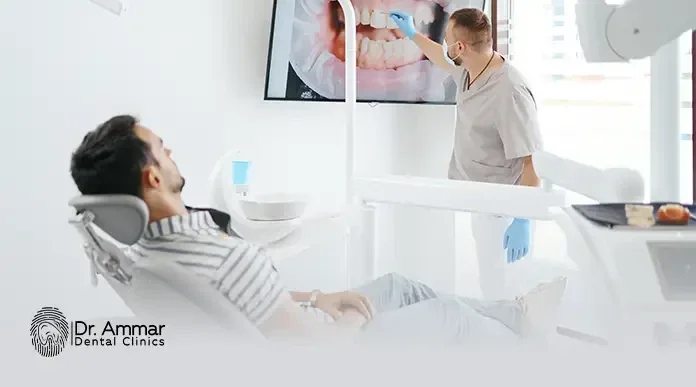
Losing teeth does not only affect the appearance of a smile; it can also lead to difficulty in chewing, speaking, and feeling comfortable while eating. This makes replacing missing teeth an important step to restore oral functions and natural appearance. With the variety of available solutions, many people begin searching for the difference between dental prosthetics (bridges/crowns) and dental implants to understand the nature of each procedure, its advantages, and its suitability for their condition.
In this article, we will explore the difference between dental prosthetics and dental implants in terms of usage and cost, provide a comparison explaining the difference between the two, discuss how to choose the appropriate solution for each case, and highlight the role of Dr. Ammar Clinics in providing treatment options that help you restore your smile with confidence. Read on to discover all the details.
Overview of the Difference Between Dental Prosthetics and Dental Implants
The difference between dental prosthetics and dental implants lies in the nature of each procedure and the way a missing tooth is replaced. Dental prosthetics rely on replacing missing teeth using artificial restorations, such as crowns and bridges, which are supported and anchored by one or more natural teeth.
Dental implants, on the other hand, rely on securing a metal fixture inside the jawbone to act as an artificial root, followed by placing a crown or artificial tooth over it. Thus, implants provide a stable base to replace missing teeth without depending on adjacent teeth in many cases, whereas traditional prosthetics focus on replacing the visible part of the missing tooth or teeth.
At Dr. Ammar Clinics for Dentistry, Cosmetics, and Implants, we ensure clarity regarding the available treatment options for each case through a precise evaluation of the teeth, gums, and jawbone. Contact us and book your consultation today to learn more details about the difference between dental prosthetics and dental implants and determine the appropriate treatment steps for your condition.
The Difference in Terms of Usage
The usage differences between dental prosthetics and dental implants depend on the condition of the original tooth, the extent of its damage, and whether it can be preserved or is entirely missing. Prosthetics are used to restore severely damaged natural teeth or replace missing ones using crowns, bridges, and dentures, whereas dental implants rely on securing a fixture inside the jawbone to replace the missing tooth root, followed by placing an artificial tooth after fulfilling treatment requirements.
The usage differences can be outlined as follows:
First: Dental Prosthetics
Dental prosthetics are used in numerous cases requiring the restoration of natural teeth or the replacement of missing ones, most notably:
Restoring teeth severely damaged by deep decay or fractures.
Covering teeth after procedures such as root canal treatments when necessary.
Replacing missing teeth using bridges or dentures.
Enhancing tooth shape and color using cosmetic crowns in appropriate cases.
Second: Dental Implants
Dental implants are used to replace completely missing teeth through fixtures that act as alternatives to natural tooth roots. Key uses include:
Replacing a single missing tooth or multiple teeth.
Replacing missing posterior teeth to restore chewing efficiency.
Replacing full-arch missing teeth using implant-supported restorations.
Providing a stable base for replacement teeth without relying on adjacent teeth in many cases.
Thus, understanding the uses of each procedure provides a clearer picture of the difference between them, though a clinical examination remains essential to determine the proper method based on the tooth's condition.
The Difference in Terms of Cost
The cost of replacing missing teeth varies according to the type of procedure, materials used, and the number of teeth to be replaced, making cost comparison an important factor when making treatment decisions.
In Egypt, the price of a dental implant ranges from 12,000 to 25,000 EGP per single tooth, while a full-arch denture implant ranges from 90,000 to 235,000 EGP per jaw, depending on implant types, technologies utilized, and individual case requirements.
As for fixed prosthetics, prices typically range from 1,500 to 5,750 EGP per tooth depending on the type of restoration: porcelain crowns range from 750 to 2,300 EGP, Zirconia starts at 3,750 EGP, and E-max restorations can reach up to 5,750 EGP. Regarding removable prosthetics, a full denture set ranges from 7,000 to 10,000 EGP per jaw.
Because determining the final cost depends on examining the teeth and jawbone, selecting the type of restoration or implant, and any preparatory procedures required before treatment, do not hesitate to book your consultation with us at Dr. Ammar Clinics to accurately evaluate your condition and receive specialized guidance.
Comparison Between Dental Prosthetics and Dental Implants
The difference between dental prosthetics and dental implants appears in the replacement method, fixation mechanism, treatment duration, and cost. Choosing between them depends on the condition of remaining teeth, gum health, jawbone condition, patient needs, and the specifications of each procedure.
The following table highlights the main differences to help you understand available options before deciding on treatment:
Comparison Point | Dental Prosthetics | Dental Implants |
Replacement Method | Replacing missing teeth with fixed crowns, bridges, or removable dentures, depending on the case. | Securing a fixture inside the jawbone to replace the missing root, followed by placing a crown or restoration over it. |
Fixation Method | May rely on adjacent teeth or gums, depending on the type of restoration. | Relies on the osseointegration of the implant with the jawbone to provide a stable base for the replacement tooth. |
Surgical Intervention | Most traditional prosthetics do not require surgery, but may require preparing supporting teeth. | Requires surgery to secure the fixture inside the jawbone. |
Treatment Duration | Shorter duration, depending on the type of restoration and oral condition. | Generally takes longer due to the need for tissue healing and bone integration. |
Impact on Adjacent Teeth | Traditional bridges may require preparing adjacent natural teeth for support. | The implant does not rely on adjacent teeth for fixation. |
Cost | Generally lower, starting from 1,500 up to 6,000 EGP depending on the restoration type. | Generally higher in most cases, ranging from 12,000 to 25,000 EGP. |
Choosing between prosthetics and implants depends on oral and jawbone health, the number of teeth to be replaced, budget, and treatment expectations. At Dr. Ammar Clinics, we evaluate each case and explain the differences in advantages, costs, and stages; contact us and book your consultation to explore suitable replacement options.
The Difference in Terms of Types
Within the context of comparing prosthetics and implants, various options are available to replace missing teeth or restore damaged ones, with each type differing in fixation method, number of teeth replaced, and treatment requirements.
First: Types of Dental Prosthetics
Crowns (Caps): Used to cover damaged teeth, restore their shape and function, and protect teeth following root canal treatments.
Fixed Bridges: Replace one or more missing teeth by relying on adjacent natural teeth for support.
Removable Dentures: Used to replace some or all teeth, and can be removed for cleaning and daily maintenance.
Second: Types of Dental Implants
Traditional Dental Implants: The fixture is anchored inside the jawbone, and the replacement tooth is attached after a healing period based on the treatment plan.
Immediate Dental Implants: The fixture is placed during the same session as the tooth extraction or immediately after, if bone and gum conditions permit.
3D Digital Implants: Relies on digital imaging and planning to precisely determine implant positioning prior to the procedure.
Guided Surgery Implants: Utilizes a surgical guide to assist in placing the implant in the pre-planned position.
Understanding the types helps you make a more conscious step toward restoring your smile and chewing comfort. At Dr. Ammar Clinics, book your consultation now, and let us help you restore your smile and dental function precisely and safely.
Which Is Better: Dental Prosthetics or Dental Implants?
Choosing the appropriate procedure depends on the health of your teeth, gums, and jawbone, and whether a damaged tooth can still be restored or is completely missing. If a tooth is present but damaged, a crown may be suitable to restore its shape and function. If the tooth is completely lost, an implant may be the appropriate choice. The clinician determines the procedure following an examination, taking into account the number of teeth to be replaced, budget, and available timeline.
Can You Have Dental Prosthetics Without Implants?
Yes, missing teeth can be replaced without resorting to implants by using fixed bridges or removable dentures. The choice depends on the number of missing teeth, the condition of adjacent teeth, and gum health. Bridges rely on adjacent teeth for support, while removable dentures offer flexibility since they can be removed daily for cleaning. Contact us at Dr. Ammar Clinics to schedule your consultation and explore suitable replacement options for your dental condition.
Why Choose Dr. Ammar Clinics for Prosthetics and Implants in Egypt?
Choosing the right clinician is an essential step to determine the procedure matching your oral and dental health. At Dr. Ammar Clinics for Dentistry, Cosmetics, and Implants, we ensure a precise evaluation of every case, rely on modern technologies, outline clear treatment plans, and provide continuous follow-up during and after treatment.
Key advantages of Dr. Ammar Clinics:
Extensive experience in restorative, cosmetic, and implant dentistry, capable of handling diverse cases.
A distinguished medical team dedicated to accurately evaluating oral and dental health.
Reliance on modern technologies for diagnosis and treatment planning.
Specialized consultations regarding the differences between prosthetics and implants to help understand available choices.
Customized treatment plans tailored to individual patient needs and jawbone conditions.
Continuous monitoring throughout all treatment phases and post-procedure recovery.
Multiple branch locations to facilitate easy access to clinic services.
Streamlined scheduling and treatment coordination for international patients, particularly from Saudi Arabia.
Ultimately, deciding to replace missing teeth goes beyond knowing the differences between prosthetics and implants; it begins with understanding your unique case needs and choosing the procedure that restores chewing efficiency and smile aesthetics.
At Dr. Ammar Clinics, we provide comprehensive care starting with accurate diagnosis to build a proper treatment plan. Do not let missing teeth affect your comfort and self-confidence; book your consultation with us now at Dr. Ammar Clinics and discover replacement options designed to restore your smile with confidence and reassurance.