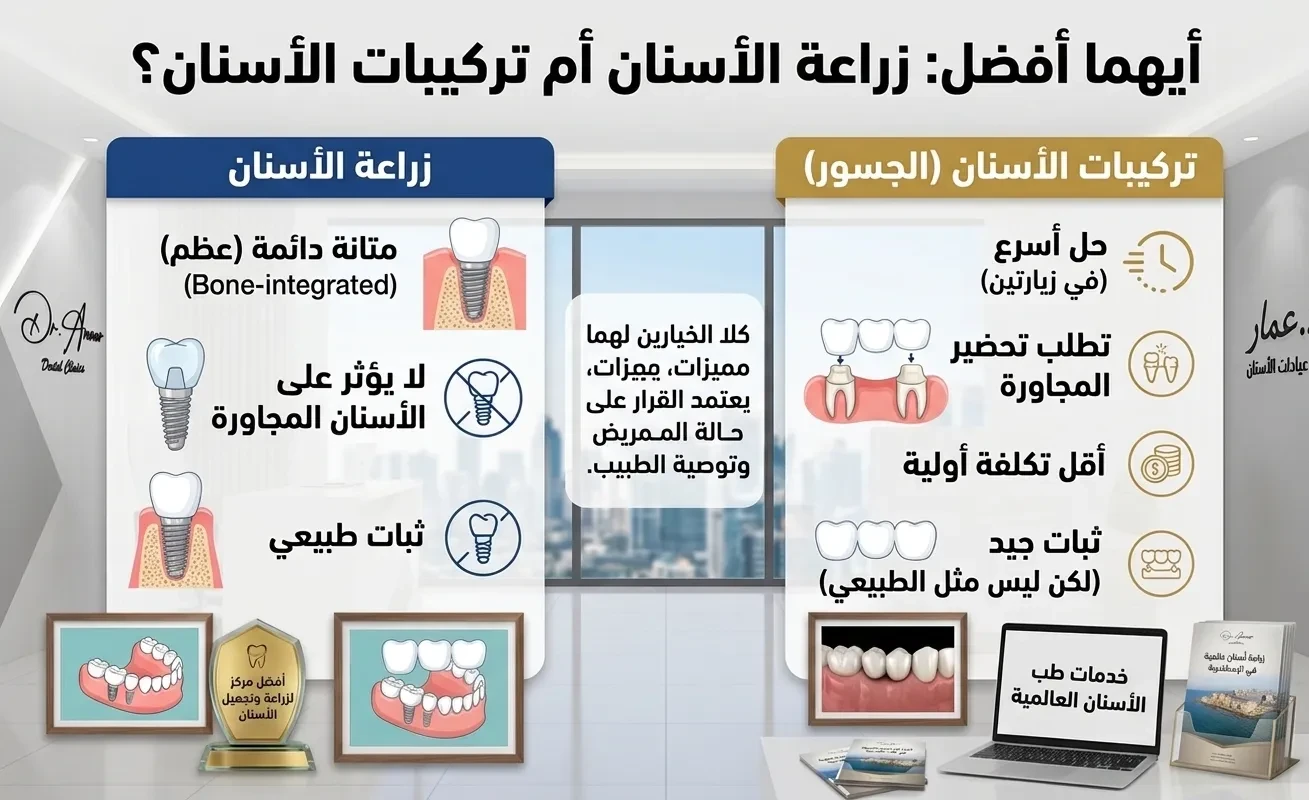
Which is better: dental implants or dental prosthetics?
Tooth loss is a significant issue that affects masticatory function and smile aesthetics. Various solutions are available to replace missing teeth, most notably dental implants, traditional dentures, and dental bridges. Because each option has its own characteristics, advantages, and limitations, many patients seek a clear answer to a fundamental question: Which is better—dental implants, dentures, or dental bridges? And which solution provides the most optimal result for their specific case and needs?
In this article, we explain the differences between dental implants, dentures, and bridges, highlight the key factors that determine the best replacement option, and discuss the role of Dr. Ammar Dental Clinics in providing integrated solutions for missing teeth through personalized treatment planning.
Dental Implants vs. Dentures: Which Is Better?
When evaluating whether dental implants or dentures are better, there is no single answer that fits every patient. Each method possesses unique characteristics, and the choice depends on several factors: the number of missing teeth, jawbone density, periodontal health, the condition of adjacent teeth, patient preferences, and desired clinical outcomes.
- Dental Implants: A widely preferred solution for replacing missing teeth, suitable for most clinical presentations. The procedure involves surgically anchoring a metallic fixture (implant) into the jawbone, onto which a final crown or prosthesis is placed after osseointegration. This restores tooth function and natural aesthetics very closely to real teeth.
- Traditional Dentures & Prostheses: Used to replace missing or severely damaged teeth. Their design and retention mechanisms vary according to oral conditions and surrounding teeth. Determining whether implants or traditional dentures are better requires a detailed clinical evaluation of the patient's health and aesthetic requirements.
At Dr. Ammar Dental Clinics, we thoroughly examine your teeth and jaw structure to evaluate all suitable options before commencing treatment. If you are uncertain whether dental implants or dentures are right for your case, schedule a consultation with our clinical team to guide you toward the ideal treatment path.
Dental Implants vs. Dental Bridges: Which Is Better?
When comparing dental implants to dental bridges, it is essential to understand the structural differences between them. A dental bridge relies on the natural teeth adjacent to the gap (abutment teeth) to anchor the replacement pontic. In contrast, a dental implant consists of an independent artificial root inserted into the jawbone, topped by a customized crown once healing is complete.
- Dental Implants: An ideal choice for most cases because they replace missing teeth without altering or compromising neighboring healthy teeth.
- Dental Bridges: A suitable alternative when adjacent teeth are strong enough to support the bridge and the surrounding bone and gum tissue are healthy.
Therefore, deciding between an implant and a bridge depends not only on personal preference, but also on the structural health of adjacent teeth, periodontal condition, available bone volume, and the number of missing teeth—all of which are assessed during a comprehensive clinical examination.
What Is the Difference Between Dental Implants, Dentures, and Dental Bridges?
Dental implants, dentures, and dental bridges differ in their mechanisms of replacing missing teeth, retention methods, advantages, drawbacks, and clinical indications. Understanding these differences helps patients form a clearer picture of their options.
The comparison table below outlines the key differences:
|
Comparison Point |
Dental Implants |
Dentures / Removable & Fixed Prostheses |
Dental Bridges |
|
Procedure Nature |
Replacing the missing tooth via an artificial root anchored in the jawbone, followed by crown placement after healing. |
Replacing damaged or missing teeth using fixed or removable appliances based on clinical needs. |
Replacing one or more missing teeth using a framework supported by adjacent healthy teeth. |
|
Advantages |
Exceptional stability; natural appearance; preserves adjacent teeth without shaving; prevents jawbone resorption. |
Offers versatile solutions for cases where surgery is contraindicated; customizable materials and designs. |
Quicker execution; generally lower upfront cost than implants; non-surgical procedure. |
|
Drawbacks |
Requires minor surgery and an osseointegration healing period; relatively higher initial cost. |
Varies by design; removable types require ongoing maintenance and adjustment over time. |
Requires shaving/reduction of healthy adjacent teeth; does not replace the root, leading to potential bone loss underneath. |
|
Treatment Steps |
Diagnostic imaging, surgical implant placement, osseointegration healing phase, final crown placement, and follow-up. |
Varies by prosthesis type; includes tooth preparation, impressions, laboratory fabrication, and final fitting. |
Abutment tooth preparation, precision impressions, lab fabrication, and final cementation onto adjacent teeth. |
|
Types |
Conventional, immediate loading, guided surgery, or advanced full-arch protocols (e.g., All-on-4, All-on-6). |
Fixed crowns/bridges or removable partial/full dentures, with various material compositions. |
Traditional fixed bridges, Maryland bridges, implant-supported bridges, or cantilever bridges. |
|
Suitable Cases |
Patients with adequate jawbone density and healthy periodontal tissue to support the fixture. |
Diverse cases depending on the number of missing teeth, bone health, and patient preferences. |
Cases with healthy, strong adjacent anchor teeth, especially when rapid tooth replacement is required. |
|
Cost Range (Egypt) |
Starting from 12,000 EGP per tooth (varies by system, technique, and preliminary procedures). |
Starting from 1,500 to 5,750 EGP depending on materials, type, and preparation needed. |
Varies according to bridge type, number of units, and material selected (e.g., Zirconia, PFM). |
|
Treatment Duration |
Longer timeline due to the bone healing phase (typically ranging from a few weeks to several months). |
Faster than implants; timeline varies depending on prosthesis type and dental laboratory work. |
Generally faster than implants, completed over a few clinical appointments. |
As shown, no single option is universally superior for every patient. The optimal choice relies on a professional evaluation of the teeth, gums, jawbone structure, number of missing units, and individual health requirements.
Advantages of Dental Implants
When evaluating tooth replacement options, dental implants are widely regarded as the gold standard for several compelling reasons:
- Natural Aesthetic Appearance: Blends seamlessly with natural teeth.
- Optimal Masticatory Stability: Restores full bite force and speech clarity.
- Long-Term Solution: Designed for permanent durability without frequent replacement.
- Preservation of Adjacent Teeth: Requires zero grinding or reduction of neighboring healthy teeth.
- Bone Preservation: Stimulates the jawbone and prevents bone resorption caused by tooth loss.
- High Success Rates: Safe and clinically proven with success rates exceeding 95–98% in healthy individuals.
Disadvantages of Dental Bridges
Understanding the limitations of dental bridges is crucial when deciding between implants and bridges:
- Enamel Reduction: Requires filing down healthy adjacent teeth to serve as anchor crowns.
- Increased Structural Stress: Adds extra mechanical load to the supporting abutment teeth over time.
- Hygiene Challenges: Demands meticulous cleaning under the pontic to prevent secondary decay or gum inflammation.
- Lack of Bone Preservation: Does not replace the root structure, leading to gradual jawbone loss beneath the bridge.
- Lifespan Limitations: May require replacement or repair after several years depending on wear and oral hygiene.
Contraindications for Dental Implants
While dental implants are highly effective, certain health or oral conditions may affect bone healing and implant stability. Implants may be temporarily or permanently contraindicated in cases such as:
- Uncontrolled chronic medical conditions (e.g., uncontrolled diabetes).
- Severe jawbone deficiency (unless bone grafting is performed beforehand).
- Active periodontal disease or untreated oral infections.
- Heavy smoking or inability to refrain from smoking during the recovery phase.
- Severe, unmanaged bruxism (teeth grinding).
- Inadequate oral hygiene and lack of commitment to follow-up care.
- Complex anatomical constraints (e.g., extreme proximity to nerves or sinus cavities requiring preliminary procedures).
Note: Having one of these conditions does not automatically rule out implants. Many pre-existing issues can be treated or prepared beforehand, allowing your dentist to re-evaluate suitability.
How Long Do Dental Bridges Last?
On average, a dental bridge lasts 10 years or longer with proper oral hygiene, care for abutment teeth, and routine dental checkups. The exact lifespan varies according to bridge material, periodontal health, and home-care habits.
Do Dental Implants Last Longer Than Bridges?
Yes. In terms of longevity, dental implants generally outlast dental bridges and can endure for a lifetime when successfully integrated and maintained with proper oral hygiene. However, long-term success for both options depends on continuous care, regular checkups, and professional monitoring.
Cost Comparison: Dental Implants vs. Bridges and Dentures
Cost is an important factor for most patients when deciding on a treatment plan. In Egypt, dental implants range from 12,000 EGP to 25,000 EGP per tooth. While implants may carry a higher initial investment than some bridges or dentures, they offer superior stability, bone preservation, and long-term durability.
Key Factors Influencing Cost:
- Number of teeth requiring replacement.
- Selected implant brand, system, and crown material (e.g., Zirconia).
- Jawbone density and the need for bone grafting or sinus lifts.
- Pre-surgical diagnostic imaging (3D CBCT scans and digital planning).
- Complexity of the clinical case and customized treatment plan.
At Dr. Ammar Dental Clinics, we outline all suitable treatment options and expected costs clearly during your initial consultation.
How Does the Dentist Determine the Best Option for You?
Clinicians determine whether implants, bridges, or dentures are best by conducting a thorough oral examination supported by 3D digital X-rays (CBCT). Key diagnostic criteria include:
- Number and location of missing teeth.
- Jawbone quantity, height, and density.
- Health of surrounding gums and remaining natural teeth.
- Presence and management of systemic medical conditions.
- Occlusal alignment and bite distribution.
- Patient commitment to post-treatment care and maintenance.
- Patient timeline and budget preferences.
Based on these parameters, your dentist will present a clear, tailored recommendation aligned with your health and aesthetic goals.
Why Choose Dr. Ammar Dental Clinics to Restore Your Smile?
At Dr. Ammar Dental Clinics, we believe that successfully replacing missing teeth begins with precise diagnosis and meticulous planning. We evaluate each case individually to determine whether implants, bridges, or dentures offer the safest, most durable outcome.
Our clinic offers a complete treatment experience powered by 3D digital planning and modern technology, ensuring functional efficiency and natural aesthetic results.
Key Advantages at Dr. Ammar Dental Clinics:
- 3D Digital Diagnostic & Surgical Planning: Enhanced accuracy and predictable results.
- Expert Clinical Team: Specialized practitioners trained at top Egyptian and European universities.
- Comprehensive Options: Tailored selection between implants, bridges, and dentures based on individual needs.
- Continuous Patient Follow-Up: Dedicated post-procedure care to ensure optimal healing and longevity.
- High-Quality Implant Systems: Utilizing top global implant brands with verified long-term success rates.
- Multiple Convenient Locations: Modern branches across Cairo and Mansoura.
Restore Your Smile with Confidence
Replacing missing teeth restores both oral function and daily comfort. At Dr. Ammar Dental Clinics, your treatment journey begins with a detailed evaluation, transparent guidance, and step-by-step care using state-of-the-art dental technology.
Contact Dr. Ammar Dental Clinics today to schedule your consultation and take the first step toward restoring your healthy, confident smile.